David Janssen
Pastor of Spiritual Growth
Grace Community Bible Church
Sandy, Utah
I. INTRODUCTION
“If someone really believes in Jesus for everlasting life, their life will show it through their good works.”
“Good works prove someone is saved.”
You have likely heard or made statements similar to these. Don’t these explanations sound reasonable? Someone who believes in Jesus should show his or her “new life” (2 Cor 5:17). People generally look at others who believe in Jesus to see if they act “like a Christian.” To the point, The Babylon Bee reports: “Local believer shows no evidence of salvation before morning coffee.”1
But we must ask: “Is it true? What does the Bible teach?”
I want to make the case that good works do not prove whether or not someone has eternal life, because “Faith without works is still faith.” A person receives the gift of eternal life by believing in Jesus for eternal life independent of any good works he or she does. Although there are many issues regarding the relationship between faith and work, we must start with the foundation that “Faith without works is still faith.” I will first address two flawed approaches to requiring works in order to receive eternal life.
II. FLAWED APPROACH ONE: ADDING WORKS TO FAITH
This approach could be described as “belief in Jesus and something else.” This perspective views “belief in Jesus” as insufficient. Justification salvation2 requires belief and works. Works are defined by whatever church or religious group is making the statement. Works could include water baptism, making Jesus Lord of your life, other religious rituals, or confessing all your sins.
Although it is common for Catholics and Mormons to require works, I find it increasingly common for people in Evangelical churches to add the requirement of works as well.
A. Illustration One: Mormonism Adds Works as a Requirement
Let me illustrate how Mormonism adds works to faith, since my ministry is in Utah and I regularly converse with Mormons. When I ask Mormon missionaries what a person must do to be saved, they will typically answer “A person is saved by faith in Jesus Christ our Savior.” When I ask them about the requirement of good works, they will say something like, “If a person really believes in Jesus Christ, then it will show up in their good works.”
Sound familiar? They say exactly the same thing that Reformed and Lordship Salvation people say.
When you interact with Mormons, you need to understand that they use Biblical or theological words differently from the way Evangelicals use them. This means that you need to ask them what they mean by what they say. You must do this repeatedly.
Even though they say, “Salvation is by believing in Jesus Christ our Savior,” and that “people are saved by grace,” the LDS Church teaches that these phrases mean something different from our understanding of them. It is worth asking Mormons to explain 2 Nephi 25:23 in the Book of Mormon, which says, “We know that it is by grace, that we are saved, after all we can do.”
Did you catch the phrase “after all we can do”? LDS grace does not kick in until you have done “all you can do.” I ask them, “Have you done ‘all you can do’?” No Mormon has told me he or she has met that requirement. This is rightly called “the impossible gospel.”
If you do some more digging, you will find that the Mormon Church is very clear on what it thinks about “belief in Jesus Christ alone” for salvation. The twelfth president of the LDS Church was Spencer W. Kimball.3 In The Miracle of Forgiveness, Kimball says, “One of the most fallacious doctrines originated by Satan and propounded by man is that man is saved alone by the grace of God; that belief in Jesus Christ alone is all that is needed for salvation.”4
Not only do they agree that belief in Jesus for salvation is wrong, but they also view such a belief as coming straight from Satan.
So, despite what the Mormon missionaries say, their church completely rejects a Free Grace view of the sufficiency of belief in Jesus for eternal life. Hence, LDS people commonly tell me, “I cannot accept that just believing in Jesus is enough. You have to do good works.”
You may be asking, “Why this material about Mormonism?” Even though Mormonism clearly teaches the requirement of works for eternal life, it is not forthcoming in presenting that belief to people.
Mormons sound as if they are teaching “faith alone in Christ alone,” but they are not. The same thing sometimes happens in Evangelical churches. They may sound as if their message is a clear Free Grace message that does not add works; however, when you ask more questions, you find out that works are required. In my experience, it is not uncommon for people, even some in Free Grace churches, to think that good works are necessary for eternal salvation.
B. Illustration Two: John MacArthur Says Works Are Proof of Saving Faith
This view sees good works as proof, or the concrete evidence, of saving faith. I appreciate John MacArthur being clear on this point. Consider the following short quotes (emphasis added):
Faith is by nature turned and toned toward obedience (Acts 5:32; Rom 1:5, 2:8, 16:26), so good works are inevitable in the life of one who truly believes. These works have no part in bringing about salvation (Eph 2:9; Rom 3:20, 24; 4:5; Titus 3:5), but they show that salvation is indeed present (Eph. 2:10; 5:9; 1 John 2:5).5
Again, we must be clear: Obedience does not produce or maintain salvation, but it is the inevitable characteristic of those who are saved.6
The apostle Paul in particular was a champion of the great doctrine of justification by faith. Yet he recognized the lordship of Christ (Rom 10:9-10) and the place of works in a believer’s life (Eph 2:10). For him, faith was not a dormant quality that might fail to produce righteous fruit. He saw practical righteousness as the necessary and inevitable result of true faith.7
The inevitable result of genuine salvation is good works.8
The above quotes indicate that MacArthur likes the word inevitable. Inevitable points to good works as certain to happen. They are unavoidable for a true believer. The word inevitable allows some leeway for when good works will show up, but no question as to whether they will show up. Although MacArthur does not use the word automatic, in a sense, he teaches that the outcome of good works will be automatic. They will certainly happen at some point. This idea of good works being inevitable, certain, automatic, or guaranteed to happen at some point is simply not found in the NT.
In fact, the opposite is found. Since good works are not inevitable, certain, automatic, or guaranteed, God commands to believers as to what they should do. The believer ends up choosing to obey or not to obey. If good works were inevitable, no commands would be necessary.
In the NT letters, written to believers during this dispensation, there are 568 Greek imperatives or commands. Most of these are transferable and applicable to believers today. “Faith without works is still faith” because a believer in Jesus can choose not to obey the NT commands, and, hence, can be “without works.”
C. Does the Message of Life9 in the Bible Add Works?
In wrestling with the relationship between good works and faith, it is important to be clear about what is meant by faith. Faith means to believe something—but to believe what? The answer is: the message of life. The content of the message of life is found primarily in the Gospel of John, but also in other NT places. I find Paul’s comments in 1 Tim 1:15-16 to be informative and helpful.
It is a trustworthy statement, deserving full acceptance, that Christ Jesus came into the world to save sinners, among whom I am foremost. Yet for this reason I found mercy, so that in me as the foremost sinner Jesus Christ might demonstrate His perfect patience as an example for those who would believe in Him for eternal life (NAS20, emphasis added).
Paul is writing to Timothy, who is in Ephesus, where Paul had spent about three years10 on his third missionary journey (Acts 18–21). He first addresses “strange doctrines” (1:3) and whatever is “contrary to sound teaching” (1:10). He then thanks Jesus for “putting [Paul] into service” (1:12) even though he is a sinner (1:13) and considers himself the foremost sinner (1:15). In 1:16, he points to himself as an example of Jesus Christ showing mercy and patience to him, a sinner, thus giving hope for others to believe and find the same mercy.
Then Paul exhorts Timothy to “fight the good fight” (1:18) and to “keep faith and a good conscience” (1:19).
In 1:16, Paul uses a very informative phrase: “For those who would believe in Him for eternal life.”
This is the most concise statement in Paul’s writing of the requirement for receiving eternal life. It has three parts: 1) believe (not behave); 2) in Him (in the only One who promises eternal life); and 3) for eternal life (not for other things, such as physical healing, getting a job, or winning the lottery). As Robert Vacendak states: “When people believe in Christ, they are believing in Him for a specific reason—in order to live eternally.”11
When presenting the message of life, the irreducible requirement is: “Believe in Jesus for eternal life.” None of the elements is optional.
Paul makes no mention of works as being required. This is not an argument from silence, but an argument about silence. In both 1 and 2 Timothy, Paul talks about the importance of good works several times, but never as a requirement for eternal life, nor as an integral part of faith, nor as an inevitable result of believing. Note Paul’s comments on works in just these four verses (emphasis added):12
. . . having a reputation for good works; and if she has brought up children, if she has shown hospitality to strangers, if she has washed the saints’ feet, if she has assisted those in distress, and if she has devoted herself to every good work. (1 Tim 5:10)
Instruct them to do good, to be rich in good works, to be generous and ready to share… (1 Tim 6:18)
Therefore, if anyone cleanses himself from these things, he will be an implement for honor, sanctified, useful to the Master, prepared for every good work. (2 Tim 2:21)
. . . so that the man [or woman] of God may be fully capable, equipped for every good work. (2 Tim 3:17)
Clearly, Paul does not hesitate to talk about and encourage good works in his letters to Timothy. But in 1 Tim 1:16, Paul does not even mention good works. The most concise way to state the message of life is: “Believe in Jesus for eternal life.” Isn’t that refreshing? It is not complicated or confusing.
III. FLAWED APPROACH TWO: INTEGRATING WORKS INTO FAITH
A. Illustration: Thomas Schreiner Integrates Works into Faith
Thomas Schreiner is a professor of NT at the Southern Baptist Theological Seminary in Louisville, Kentucky. He has written many books, including Faith Alone: The Doctrine of Justification. Chapter 16 of this book is titled, “The Role of Good Works in Justification.”
On page 191 he writes: “The New Testament clearly teaches that bare faith cannot save, and that works are necessary for final justification or final salvation.”13
In context, this sentence is a good summary of what he presents in chapter 16. “Works are necessary” seems like an odd statement to find in a book about faith alone because of its apparent conflict with the title.
Here are a few observations about Schreiner’s sentence:
a. “The New Testament clearly teaches” may be clear to him, but not to numerous other people, including myself. His perspective requires a Reformed or Lordship Salvation interpretation of certain passages to support his view. He finds support for his views in the passage of the four soils (James 2, 1 John, and Matthew 7)––which he covers in chapter 16.
b. “Bare faith cannot save” adds the qualifier bare to faith. Bare faith is not found in the Bible. The only qualifying words I can find before faith in the NT are: great (twice),14 little (five times),15 and sincere (twice).16
For Schreiner, bare faith means “intellectual assent.”17 He describes this kind of faith as one that does not result in eternal life by saying, “A ‘claiming’ faith, a ‘saying’ faith, an ‘assenting’ faith without any accompanying works is not a saving faith.”18
Once again, he states the requirement for “accompanying works.” Notice that he adds another qualifying word––saving––to faith. This phrase is not found in the Bible. Putting qualifiers on faith creates different “kinds” of faith. Despite the biased NET translation of Jas 2:14 (emphasis mine), “Can this kind of faith save him?” (compare to the NKJV “Can faith save him?”), the Bible does not speak of different kinds of faith. The Bible does talk about faith having different objects or content, but not different kinds of faith.19
c. “Final justification or final salvation” is another example of adding qualifying words before a significant term, resulting in a phrase not found in the Bible. Other theologians have begun to write about “initial salvation” and “final salvation.” Here (Figure 1) is a diagram of what they say:
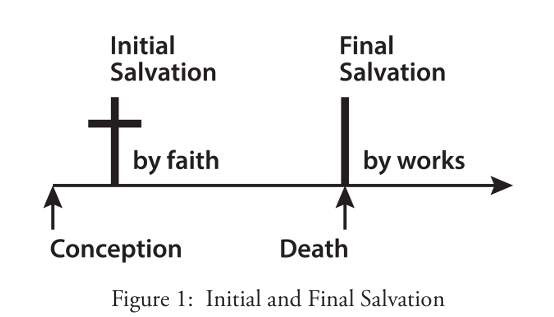
The arrow represents the timeline of a person’s life. It begins at conception, when we become individual human beings created by God. Our physical life continues until we die. Hopefully, sometime along the way, we believe in Jesus for eternal life.
Reformed writers increasingly refer to the point of believing in Jesus for eternal life as “Initial Salvation.” They view this as being by faith alone. But since a person has to persevere in faith and good works until the end of his or her physical life, they refer to the point of death as “Final Salvation.” This final salvation is by works in the sense that a person’s good works confirm their genuine faith.20 Or, in Thomas Schreiner’s language, “works are necessary for final justification or final salvation.”
In the phrase, “bare faith cannot save,” we see from Schreiner’s perspective that bare faith is insufficient, and not effective. In other words, something is missing. It is incomplete.
I am going to illustrate my understanding of what Schreiner is saying with two circles. This is my diagram, not Thomas Schreiner’s. He might say that my diagram does not accurately represent his view. I am not intending to misrepresent him.
Because “bare faith cannot save,” the “bare faith” circle has a section missing (Figure 2). It is incomplete because “works are necessary.”

If that missing section is filled in with works, then the overall picture of faith is considered, from Schreiner’s perspective, to be “genuine faith” (Figure 3).

Integrating works (“works are necessary”) into faith fills in the gap, or incompleteness, of “bare faith” and results in “genuine faith.”
B. Problems with Dividing Salvation into Initial Salvation and Final Salvation
The NT never divides salvation into initial salvation and final salvation. Nor does it ever divide justification into initial justification and final justification. These concepts are foreign to the NT.
The Bible does talk about being delivered (i.e., saved) from various things or situations. Paul was delivered (Greek salvation) from death on a boat in Acts 27:34. The disciples were delivered (Greek saved) from drowning in Matt 8:25. Many were delivered (Greek saved or were cured) from sickness in Mark 6:56. Gentile believers are delivered (“have been saved” = justification salvation before God) from eternal condemnation in Eph 2:8-9. Noah and his family were delivered (Greek saved through) from death during the flood. So, salvation can be from a variety of situations, but the NT knows nothing of “Initial Salvation” and “Final Salvation.”
The NT never presents two kinds of “justification before God” salvations––one by faith and one by works––that determine whether a person has eternal life. Rather, when a person believes in Jesus for eternal life, he or she has eternal life at the moment he or she believes. Notice the present tense has (twice) in John 5:24:
Truly, truly, I say to you, the one who hears My word, and believes Him who sent Me, has eternal life, and does not come into judgment, but has passed out of death into life.
We believe in Jesus for eternal life and it starts immediately!
We do not live our physical life on probation to see whether we are good enough at the end of life to receive eternal life. Jeremy Myers in his book What is Faith? says, “Faith does not begin with simple belief, and then end with allegiance…[or] ongoing obedience.”21
C. Problems with Integrating Works into the Meaning of Faith
Schreiner’s statement mingles faith and works. He clearly states that genuine faith has to include works. He is saying something slightly different from the assertion that works are an inevitable outcome of faith. He says that genuine faith includes works. This is a different statement because it actually makes works part of the definition of faith.
Faith and works are separate issues that cannot be confused, blended, co-mingled, merged, or mixed. It is crucial to understand that faith and works are mutually exclusive.22 That is why we can say, “Faith without works is still faith.” They are separate issues.
D. Six Verses That Show Faith and Works Are Mutually Exclusive
Let us ask the question that Paul asks in Rom 4:3: “What does the Scripture say?”
a. Romans 3:28: “For we maintain that a man is justified by faith apart from works of the Law.”
In this context, Paul first states that “God’s displeasure with humanity is manifest” (1:18–3:20). As a result, “Humanity faces God’s impartial judgment” (2:6–3:20).23 Paul then writes: “The unrighteous can obtain righteousness through Jesus Christ” (3:21–5:11).24
Paul talks about faith apart from works. He can only make such a statement if faith and works are different issues. He does not present faith as including works or works as including faith, but talks about them as being completely separate.
b. Romans 4:5: “But to the one who does not work, but believes in Him who justifies the ungodly, his faith is credited as righteousness.”
This passage is in the same section of Romans as Rom 3:28 (above).
Notice the contrast in the phrase, “not work, but believes.” This clarifies that Paul does not consider works to be part of faith.
In his commentary on Romans, Douglas Moo says, “Paul’s purpose in vv. 4-5, then, is to show that the faith that justifies is ‘faith alone,’ faith ‘apart from works.’”25
c. Galatians 2:16: “Nevertheless, knowing that a person is not justified by works of the Law but through faith in Christ Jesus, even we have believed in Christ Jesus, so that we may be justified by faith in Christ and not by works of the Law; since by works of the Law no flesh will be justified.”
The context of Gal 2:1-21 is about being clear concerning “the truth of the gospel” (v 4), stemming from the situation of Peter not eating (presumably at the Lord’s Supper)26 with the Gentiles in Antioch (v 12). Paul viewed this situation as important enough to call for correction and clarity (i.e., “not straightforward about the truth of the gospel,” v 14). This is why he called Peter out.
Paul then emphasizes in verse 16 that belief in Jesus is the only requirement for eternal life (for justification before God). Paul says it three times in this one verse: “through faith in Christ Jesus,” “even we have believed in Christ Jesus,” and “by faith in Christ.”
Just to be clear, Paul also contrasts belief with works two times in this passage: “not justified by works…but through faith,” and “justified by faith…not by works.”
Faith and works are spoken of as mutually exclusive issues. They are not mixed, nor are they confused.
d. Ephesians 2:8-9: “For by grace you have been saved through faith; and this is not of yourselves, it is the gift of God; not a result of works, so that no one may boast.”
In this context, Paul explains how God has reconciled the Jews and Gentiles to each other—and both groups to Himself.27 The focus in this passage is on how Gentiles (you) are saved (i.e., the “justification-before-God” salvation).
Notice the contrast again between faith and works: “through faith…the gift of God; not a result of works.” Faith and gift are separate and opposite from works.
Ephesians 2:8-9 gives us the relationship between grace and faith. Eternal life is “by grace,” or God’s favor, because it is a “gift of God.” Once again grace and faith are contrary to works.
e. Romans 11:6: “But if it is by grace, it is no longer on the basis of works, since otherwise grace is no longer grace.”
In the context of Romans 11, Paul addresses whether or not God has abandoned the nation of Israel. He concludes that God has not abandoned Israel. “In the same way then” (v 5)––as in the days of Elijah, so in Paul’s day––“God had kept for himself, those who had responded to His grace in Christ.”28 Paul continues, saying (v 6) that God’s keeping of Jewish believers in his day was a matter of God’s grace, not having anything to do with their Law-related works or with good deeds the people were doing.
In a wording similar to that of Eph 2:8-9, Rom 11:6 contrasts grace and works. Paul views them as mutually exclusive concepts. In this passage, Paul even says that if works of the people of Israel are somehow mixed in with God’s grace or favor, then it is no longer grace.
f. James 2:17: “In the same way, faith also, if it has no works, is dead.”
In Jas 2:1-13, James explains the importance of believers not showing partiality or discrimination toward poor people by giving rich people preferential treatment. He shows (2:14-26) how important it is for believers to act on their faith in order: 1) to be helpful to other believers; 2) to mature their faith; and 3) to see God deliver believers when they take a stand for Him against culture.29
The word dead has been explained in various ways, from “unresponsive” to “nonexistent.” Figure 4 pictures the concept of “faith without works is dead” (Jas 2:17, 20, 26).
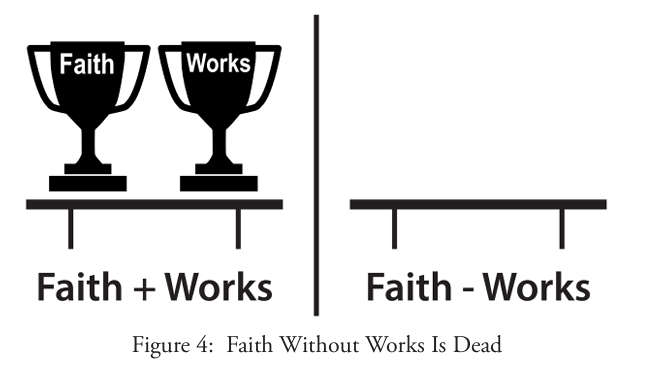
The left side represents someone who has both faith and works “on the shelf.” The person on the right may claim to have faith, but without works, faith is nonexistent.
Look once more at Jas 2:17. I did not quote the whole sentence. The entire sentence/verse reads: “In the same way, faith also, if it has no works, is dead, being by itself.” The accurate diagram (Figure 5), therefore, would look like this:
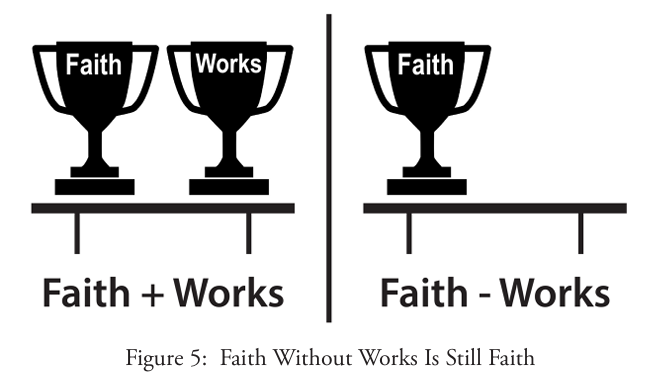
Since faith without works is “being by itself,” that means it is still there (on the right)! How can that be? Because “faith without works is still faith.”
There is no room for mixing faith and works. As Jeremy Myers accurately says, “There are no works in faith, for faith is the opposite of works.”30
IV. WHAT ABOUT, “FAITH ALONE SAVES, BUT SAVING FAITH IS NOT ALONE”?
The popular saying, “Faith alone saves, but saving faith is not alone,” tries to communicate the idea that works must follow belief. Yet the wording is not clear and, upon closer examination, does not make sense.
Let us compare the first and second phrases. If we reword the first phrase––“Faith alone saves”––to make it more like the second phrase, a person could say, “Faith alone is saving.” Let us look at it that way:
“Faith alone saves.” = “Faith alone is saving.”
Now let us look at the second phrase––“Saving faith is not alone.” If we reword this one slightly, it could say, “Faith that is not alone is saving.” Look at it this way:
“Saving faith is not alone.” = “Faith that is not alone is saving.”
Now compare: “Faith alone is saving.”
“Faith that is not alone is saving”
The two phrases contradict each other. Both statements cannot be true. The way the saying is normally expressed––“Faith alone saves, but saving faith is not alone”––basically puts two contradictory statements together in one sentence. This saying is not correct and solves nothing. For a more thorough analysis of this saying, see Fred Lybrand’s book, Back to Faith.31
V. CERTAINTY ABOUT ETERNAL LIFE
There is an ongoing discussion about whether “assurance is of the essence of saving faith.” Does a person need to know he or she has eternal life as confirmation of his or her belief? Although it is a topic worthy of much debate,32 when I talk to people on the street about Jesus, it just does not seem that difficult. Until they get to the point that they “know they have eternal life” because of what Jesus promised, they have not believed the message of life.
What does it mean to believe? My general working definition for the word believe is, “to be convinced that something is true, resulting in certainty.” As you can see, I include certainty in my definition of to believe. This is how belief works in daily life.
If you ask someone, “Do you believe this?” he or she may reply, “I am not sure,” because until the person is sure, he or she does not believe it. It is not complicated.
Before I went into ministry, I was an engineer. In that field, there is an illustration of this point.
A. Illustration: Closed-Loop Control System
Figure 6 is a diagram of a closed-loop control system with an input, process, output, and feedback.33

This process is widespread in everyday life. For example, you have a thermostat on the wall in your house that works using this closed-loop system. You set your thermostat to a specific temperature (Input). If the temperature is cooler than that setting, the furnace will be turned on (Process). When the room temperature matches the thermostat setting (Output), the thermostat will turn off the furnace based on the actual room temperature (Feedback), because it matches the temperature you set it to.
This is also a very workable model for communication. Let me apply it to sharing the message of life.
B. Application to Certainty of Eternal Life
When I am talking to someone about Jesus, toward the beginning of our conversation, I try to ask a modified Evangelism Explosion question: “When you die and stand before God, if He were to ask you, ‘Why should I let you into my Heaven?’ what would you say?” Their answer tells me what they are trusting in (what they believe) to be accepted by God. Then I tell them the message of life.
Here is how it follows the closed-loop system diagram (Figure 7). When I talk with someone about Jesus, I give them input. They are thinking and deciding whether they are persuaded or convinced (Process) about what I am saying about Jesus or not. They come to a conclusion (Output) concerning their thoughts. Either they are convinced, and thus believe, or not. I do not know what they are thinking or what they have concluded without asking for their opinion (Feedback).
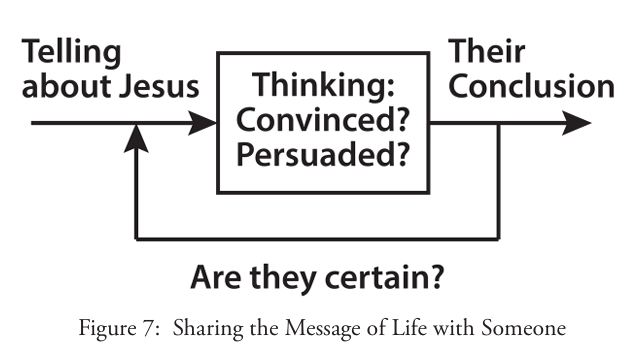
After interacting with them, I will ask them if what I have shared makes sense. Then I will ask if they believe what Jesus says. The conversation is more detailed, depending on the person and situation. If they seem to understand the message of life, I ask them again: “When you die and stand before God, if He were to ask you, ‘Why should I let you into my Heaven?’ what would you say?”
If they answer correctly (i.e., “I believe in Jesus, so I have eternal life.”), I then ask, “Anything else?” People who understand what Jesus is promising will say “no.” Others might add other things—usually works of some kind—so then we go back and review again. I am listening to see if they are certain they have eternal life based on God’s promise of eternal life rather than on their performance. I am not convinced they “believe in Jesus for eternal life” until they are clear and certain.
We see this closed-loop process in 1 John 5:11-13.
And the testimony is this, that God has given us eternal life, and this life is in His Son. The one who has the Son has the life; the one who does not have the Son of God does not have the life. These things I have written to you who believe in the name of the Son of God, so that you may know that you have eternal life.
INPUT: Verses 11 and 12. Eternal life is a gift from God. Whether a person has eternal life or not is determined by whether he or she “has the Son” or “does not have the Son.”
PROCESS: “You who believe in the name of the Son of God.…” Are they convinced or persuaded concerning Jesus and His promise of everlasting life?
OUTPUT: People are in one of two categories: Believe and have eternal life, or do not believe and do not have everlasting life. The output is digital.
FEEDBACK: They can “know” that they “have eternal life,” not just hope they have everlasting life. So, God through John wants us to have certainty about eternal life.
When someone says they believe in Jesus for eternal life, and they are 100 percent certain they have eternal life because of Jesus, then I have confidence that they understand.
VI. ONE APPLICATION: PERSONAL TESTIMONY
Sometimes we inadvertently bring works into our view of salvation, making works a requirement. This is sometimes done when people give their testimony of how they were saved.
Typically, when people prepare their testimony, they produce an outline with three parts: 1) their life before they were saved; 2) their conversion experience; and 3) how their life has changed since their conversion. I call this a “Works Testimony.”
People sometimes tell me: “You need to hear such-and-such’s testimony. It is a great one!” They usually mean Jesus has made a dramatic change in the person’s life. Seeing Jesus accomplish a dramatic change in someone’s life is fantastic. Praise Jesus! But we may accidentally communicate that receiving everlasting life is about how much we change our lives. A “great” testimony might be: “I was an evil drug dealer, then I met Jesus (usually in some dramatic experience). Then I gave away everything I owned, and now I serve the homeless full time.”
That is all great, but sometimes it sends a wrong message: Going from bad works to good works is what salvation is about.
There is also the problem of someone who is not a terrible, evil, person but has believed in Jesus to receive God’s life. There was not a dramatic change in their life because they were already functional and responsible.
I think a better approach is what I might call a “Belief Testimony.” Kathryn Wright has written about this perspective.34 In this case, people are instructed to write their testimony about: 1) their thinking before believing in Jesus; 2) the situation and circumstances of believing in Jesus; and 3) their thinking after believing in Jesus.
Before believing in Jesus, they recognize their need for God either because of their moral failures or realization that they do not have a relationship with God. They sense a need for God.
Believing in Jesus is becoming persuaded or convinced that eternal life is only found in Jesus because He offers it as a free gift. This usually comes as a result of reading or hearing one of God’s promises concerning eternal life, such as John 3:16.
The result is a certainty in knowing they have eternal life and a new relationship with God. Their thinking has changed. Perhaps their life changed as well, but that is not the main thing. What they believed changed. That is the main thing.
This outline emphasizes what a person believes and the changes in their thinking. This happens to be what my testimony looks like (see Appendix A).
The testimony I like to hear the most is of someone who was raised in a Christian home who heard the message of life many times. Then, at some point––hopefully at an early age––they realized that they needed Jesus and believed in Him for eternal life. This kind of testimony does not have the dramatic change from a terrible person to a virtual saint as its main point. It does have a focus on coming to believe in Jesus for eternal life.
VII. CONCLUSION
Biblically speaking, “Faith without works is still faith.” This truth is foundational to having certainty of everlasting life. That certainty is based on God’s promise, not our performance.
A young woman met with me who was unclear about whether or not she had eternal life. She knew her Bible fairly well but was still uncertain concerning her need for works or a changed life as proof of eternal salvation. This was the result of various unbiblical teachings she had heard. So, we looked at passages about the promise of eternal life, including 1 John 5:11-13. At the end of our discussion, I asked: “When you die and stand before God, if He were to ask you, ‘Why should I let you into my Heaven?’ what would you say?”
She replied, “I believe in Jesus.”
Then I asked, “Anything else?”
She said, “You [God] promised!”
APPENDIX A
My personal testimony illustrates what I believed and was thinking before, during, and after I believed in Jesus for everlasting life. This is not a “works” testimony but a “belief” testimony.
A. My thinking before I believed in Jesus.
I grew up attending a Lutheran church that was on the liberal end of the theological spectrum. So, the Bible was viewed respectfully but was not clearly taught.
I was baptized as a baby. I went to Confirmation, which included learning the Ten Commandments and the Apostles’ Creed.
My grandfather died when I was a senior in high school. During his funeral, I wondered: Where is my grandfather? What happens when a person dies? What will happen to me when I die? Can anybody even know?
So even though I had attended church regularly while growing up, I did not have answers to these questions.
If someone had asked me the Evangelism Explosion question, I would have probably answered: “I believe in God. I got baptized. I go to church. I try to do what is right and follow the Ten Commandments, and I hope when I get there, my good deeds outweigh my bad deeds.”
Try and hope are the keywords.
B. My thinking when I believed in Jesus.
Someone on staff with Campus Crusade for Christ came to my dormitory room and took me through the little booklet, The Four Spiritual Laws. From growing up in church, I knew 1) God loved me; 2) I was a sinner; and 3) Jesus had died on the cross for our sins. But I had not previously heard 4) I needed to believe in Jesus for eternal life. This was a new idea. I concluded that I did believe in Jesus for eternal life.
The Four Spiritual Laws booklet includes a prayer to tell God you choose to believe in Jesus. I prayed that prayer, and the experience was very disappointing.35 I expected some angels to show up, or music to play, or something spectacular to happen. I figured something this big and important should include some supernatural experience, but nothing happened. Nevertheless, I became a new creature in Christ that day during my freshman year in college because I had believed in Jesus for eternal life.
C. My thinking after I believed in Jesus.
The staff person talking to me, Dave Bair, carefully reviewed and made sure I understood that believing in Jesus for eternal life was the condition. He reviewed this in John 3:16 and John 5:24 to make sure I understood I had eternal life.
The passage that was the most impactful to me was 1 John 5:11-23. I could not believe that no one ever told me about this passage. It was amazing to find out that a person could actually know he or she had eternal life. I had wondered if that was even possible, but now I knew. There was indeed a big change in my life, but not the way many Bible teachers teach. I had certainty about where I was going to go when I died. Little did I know, the adventure had just begun.
1 “Local Believer Shows No Evidence Of Salvation Before Morning Coffee,” BabylonBee.com, Feb 16, 2017, https://babylonbee.com/news/local-believer-shows-no-evidence-salvation-morning-coffee.
2 By “justification salvation” I mean the justification that happens at the point of initial faith. When a person believes in Jesus for eternal life, he or she is also declared righteous before God. That is justification.
3 The current president of the LDS Church is Russell M. Monson. He is the seventeenth president, or living prophet, and is ninety-nine years old. So, the “prophet” of the LDS church could change before this article is published.
4 Spencer Kimball, The Miracle of Forgiveness (Salt Lake City, UT: Bookcraft, 1969), 206.
5 John F. MacArthur Jr., Faith Works: The Gospel According to the Apostles (Dallas, TX: Word Publishing, 1993), 142.
6 Ibid., 121.
7 John F. MacArthur Jr., The Gospel According to Jesus: What Does Jesus Mean When He says “Follow Me”? (Grand Rapids, MI: Zondervan, 1994), 248.
8 Ibid., 168.
9 I am grateful to John Niemelä and Dix Winston for helping me see the value of sharing the “message of life” over sharing “the gospel” since “gospel” is used in a variety of ways, but infrequently to refer to the requirement for eternal life. See Bob Wilkin’s excellent article, “What is the New Testament Gospel?” JOTGES 26 (2023): 33-45.
10 Charles Ryrie, Ryrie Study Bible (Chicago, IL: Moody Press, 1995), 1875.
11 Robert Vacendak, “Is Assurance of Salvation of the Essence of Saving Faith in the Gospel of John?” PhD diss., Liberty University, 2023, 194.
12 See also 1 Tim 2:10; 5:17; 2 Tim 1:9; 2:15; 4:5.
13 Thomas Schreiner, Faith Alone: The Doctrine of Justification (Grand Rapids, MI: Zondervan, 2015), 191.
14 Matthew 8:10 and Luke 7:9.
15 Matthew 6:30; 8:26; 14:31; 16:8; Luke 12:28.
16 First Timothy 1:5 and 2 Tim 1:5.
17 “By bare faith, I refer to what is often called intellectual assent to a set of statements, doctrines, or beliefs.” See Schreiner, Faith Alone, 191.
18 Ibid.
19 Faith is being convinced that something is true. A person can believe one thing but not another. A believer can believe in Jesus for eternal life but not believe something else He says––for example, that a believer is to forgive those who sin against him or her.
20 “People can claim to believe, but the reality of their faith is demonstrated in their actions. Their actions reveal whether they have a bare faith when they nod in mental agreement but nothing more.” Schreiner, Faith Alone, 193.
21 Jeremy Myers, What is Faith? (Dallas: Redeeming Press, 2019), 163.
22 Ibid., 126. “Both faith and works, by definition, are mutually exclusive.”
23 Zane C. Hodges, Romans: Deliverance from Wrath (Corinth, TX: Grace Evangelical Society, 2013), 18-19.
24 Ibid., 19.
25 Douglas Moo, The Epistle to the Romans, The New International Commentary on the New Testament (Grand Rapids, MI: Eerdmans Publishing Company, 1996), 265.
26 Robert N. Wilkin, “Galatians,” in The Grace New Testament Commentary, ed. Robert N. Wilkin (Denton, TX: Grace Evangelical Society, 2019), 407. “While this could refer to any meal, it most likely refers to the Lord’s Supper, because a number of NT passages suggest that the Lord’s Supper involved a full meal (e.g. Matt 26:26-30; Acts 2:42, 46; 1 Cor 11:17-34).”
27 J. B. Bond, “Ephesians,” in The Grace New Testament Commentary, ed. Robert N. Wilkin (Denton, TX: Grace Evangelical Society, 2019), 422.
28 Zane C. Hodges, “Romans,” in The Grace New Testament Commentary, ed. Robert N. Wilkin (Denton, TX: Grace Evangelical Society, 2019), 335.
29 David Janssen, “The Usefulness of Faith (James 2:14-26),” Grace in Focus (Jan & Feb 2015): 9-11.
30 Myers, What is Faith? 163.
31 Fred Lybrand, Back to Faith: Reclaiming Gospel Clarity in an Age of Incongruence (Maitlan, FL: Xulon Press, 2009). He addresses the contradiction of “Faith alone saves, but saving faith is not alone” in chapter 2: “The Cliché Is Logically Invalid.” He does so in a more nuanced and complete way than I have presented here.
32 See Vacendak, “Is Assurance of Salvation,” 391.
33 Benjamin Kuo, Automatic Control Systems (Englewood Cliffs, NJ: Prentice-Hall, 1975), 5.
34 Wright, Kathryn. “Paul’s Blueprint for How to Give Your Testimony.” FaithAlone.org, May 1, 2023. https://faithalone.org/grace-in-focus-articles/pauls-blueprint-for-how-to-give-your-testimony-acts-22/.
35 The booklet’s mention of this prayer can certainly lead to confusion. Nobody has ever been saved from the lake of fire because they prayed. They are saved by believing in Jesus for eternal life.