Grace Evangelical Society

P.O. Box 1308, Denton, TX 76202
  • About
    • Home
    • Beliefs
    • Staff
    • Board of Directors
  • Resources
    • Grace in Focus Blog
    • Grace in Focus International Blogs
    • Grace in Focus Radio
    • Grace in Focus Magazine
    • Free eBooks
    • Journal of the GES
    • Book Reviews
    • Partners in Grace Newsletter
    • Audio Messages
    • Videos
    • Email Subscription
    • Online Tracts
  • Store
    • Main Page
    • On Sale
    • Return Policy
    • Your Cart
    • Your Account
  • Events
  • Seminary
    • Seminary Info
    • GES Seminary Curriculum
    • GES Seminary Faculty
  • Connect
    • Contact Us
    • Free Grace Church and Bible Study Tracker
    • Free Grace Jobs
    • Ministry Links
  • Donate
    • One Time Donation
    • Monthly Donation
    • Your Account
  • Search
Home
→
Blog
→
The Lord’s Supper As It Was

The Lord’s Supper As It Was

February 9, 2021 by Shawn Lazar in Blog - deipnon, Lord’s Supper, William Barclay

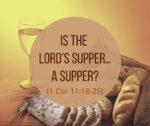
Here is the eminently readable William Barclay describing how the Lord’s Supper was originally celebrated:

It is not in doubt that the Lord’s Supper began as a family meal or a meal of friends in a private house…It was like the Jewish Passover which is a family festival and at which the father and the head of the household is the celebrant. There can be no two things more different than the celebration of the Lord’s Supper in a Christian home in the first century and in a cathedral in the twentieth century. The things are so different that it is almost possible to say that they bear no relationship to each other whatsoever. The liturgical splendor of the twentieth century was in the first century not only unthought of; it was totally impossible (Barclay, The Lord’s Supper, pp. 111-12).

The Lord’s Supper moved from being a real meal into being a symbolic meal…The idea of a tiny piece of bread and sip of wine bears no relation at all to the Lord’s Supper as it originally was. It was not until the Synod of Hippo in AD 393 that the idea of fasting communion emerged. The Lord’s Supper was originally a family meal in a household of friends (Barclay, The Lord’s Supper, p. 112).

I am amazed at the consensus that the Lord’s Supper was originally a full meal. Virtually all commentators agree—even Roman Catholic ones! And they also all agree that the celebration changed over time.

But so far, I haven’t read very many of these commentators evaluate whether it should have changed. They just accept the fact that it did and move on to the next point.

Well, that raises several questions for me, such as: should it have changed from a meal to a symbolic meal? If not, shouldn’t we change it back?

I wonder: would there be any advantages to going back to celebrating a full meal together? How could such a supper impact fellowship, friendship, sharing, discipleship, unity, evangelism, and caring for the needy and hungry? Would the setting of a full meal help or hinder those things? I’m hungry for answers!

Subscribe by Email

  • Facebook
  • X
  • Pinterest
  • LinkedIn
Shawn_L

by Shawn Lazar

Shawn Lazar (BTh, McGill; MA, VU Amsterdam) was the Editor of Grace in Focus magazine and Director of Publications for Grace Evangelical Society from May 2012 through June 2022. He and his wife Abby have three children. He has written several books including: Beyond Doubt: How to Be Sure of Your Salvation and Chosen to Serve: Why Divine Election Is to Service, Not to Eternal Life.

If you wish to ask a question about a given blog, email us your question at ges@faithalone.org.

Recently Added

January 30, 2026

How Many Evangelistic Verses Are There in John’s Gospel? 

My friend, Frank Tyler, was banned by the Latter-day Saints in multiple Southern California cities. You see, Frank didn’t wait for Mormon missionaries to come to his...
January 30, 2026

Does One’s View of the Gospel Affect Discipleship?

Welcome to the Grace in Focus podcast. Today, Bob Wilkin and Sam Marr will answer a question about discipleship and salvation. How will a person’s...
January 29, 2026

Reality of the Wilderness 

In 1731, Abbé Prévost wrote the French novel Manon Lescaut. It was one of the most controversial novels of its time and was quickly banned from publication.   The novel tells the story of...

Grace in Focus Radio

All Episodes

Listen on Apple Podcasts

Listen on Spotify

Listen on YouTube

Grace In Focus Magazine

Grace In Focus is sent to subscribers in the United States free of charge.

Subscribe for Free

The primary source of Grace Evangelical Society's funding is through charitable contributions. GES uses all contributions and proceeds from the sales of our resources to further the gospel of grace in the United States and abroad.

Donate

Grace Evangelical Society

(940) 270-8827 / ges@faithalone.org

4851 S I-35E Suite 203, Corinth, TX 76210
P.O. Box 1308, Denton, TX 76202

  • Facebook
  • Twitter
  • YouTube
  • Instagram